

The automotive industry has been navigating a prolonged transition. Electric vehicles have moved from emerging technology to an established part of the market, and that shift has reshaped demand for traditional powertrain components.
But regardless of what’s under the hood, vehicles still need seats. And those seats still need to survive a crash. Subject to some of the most stringent thermal processing specifications in automotive manufacturing, seating components represent consistent demand built around requirements that don’t change with propulsion technology.
In this article, we discuss the key thermal processes used for automotive seating components, how common materials respond, and how we deliver the repeatability that OEMs and tiered suppliers require.
what materials are commonly used in seating components?
The steels used for different automotive seating components vary depending on the part they’re being used for.
seat recliners
Because seat recliners are critical safety parts that need to survive impacts during accidents, they are required to meet very stringent levels of surface carbon. Recliner components must balance strength, ductility, weldability, and wear. Striking the correct combination of steel and heat treatment is essential.
Generally, these components are case hardened (either carburized or carbonitrided) typically using one of the following materials:
- 1010 carbon steel. 1010 is a plain carbon steel with 0.10% carbon content, fairly good machinability, and relatively low strength.
- 1020 carbon steel. 1020 carbon steel is known for having good formability and a desirable combination of strength and ductility. It can be hardened or carburized.
- 1018 carbon steel. 1018 is a free-machining grade carbon steel that is widely available around the world. Some manufacturers consider it the best option for carburized parts with a good combination of toughness, strength, and ductility.
- 10B21 boron steel. Boron steels are becoming more popular in the automotive industry due to their excellent heat treat response.
- 4130 alloy steel and 8620 alloy steel. Alloy steels are more responsive to heat treatment than plain carbon steels, so the thermal processing specifications for parts made from these materials are often adjusted to account for the material’s innate properties.
seat latches
High-strength seat latches are usually made from the following materials:
- 4140 and 4130 alloy steels. 4140 alloy steel is one of the most common materials used in manufacturing. For seat latches and hooks, 4140 and 4130 are neutral hardened to increase their strength and hardness throughout due to the high performance and precision required of these parts.
- 1050 carbon steel. 1050 is a medium carbon steel that contains 0.470-0.55% carbon content. Carbon steels are a less expensive choice when compared to alloy steels such as 4140 or 4130.

seat frames and brackets
Seat frames (also known as seat brackets) give car seats their shape using slender pieces of steel joined together to form the skeleton of the seat. These components are often made from boron steels such as 10B21 or 15B24.
Although as recently as 25 years ago, boron steels presented challenges with manufacturability, steel mills have, over time, solved these issues, and can today cast, form, and roll form them as readily as other steels. Boron steels are a good choice for seat brackets because they are only marginally more expensive than other steels used in seating but have a significantly higher hardenability, meaning they can be case hardened in less time than other steels to get the same results—creating savings in both time and expense. Because of these advantages, boron steels are becoming increasingly prevalent in the auto industry.
how are seating components heat treated?
case hardening
Seat components face a specific mechanical challenge: they need to be hard and wear-resistant on the surface to withstand repeated use, while remaining tough enough at the core to absorb impact forces in a collision without fracturing. Case hardening solves this by diffusing carbon — or carbon and nitrogen — into the surface of the part, creating a hard exterior layer over a softer, more ductile core.
carbonitriding
Seat recliners and other stamped seat components are typically made from lower-cost carbon steels. While these materials have exceptional formability and machinability, inherent hardness is lacking. Carbonitriding is especially effective in enhancing hardness once parts have been machined and formed.
In the carbonitriding process, parts are heated to approximately 1,600 degrees Fahrenheit, where a phase change occurs and both carbon and nitrogen atoms diffuse into the surface. The result is increased surface hardness, improved wear resistance, and better fatigue strength — all achieved on steels that wouldn’t develop those properties on their own. For high-volume automotive stampings, that means you get the performance the spec demands without paying for a more exotic base material.
ferritic nitrocarburizing (FNC)
For seat components where distortion is a critical concern, FNC is often the answer. Recliner mechanisms require exceptionally tight tolerances. When components distort, they don’t engage correctly. FNC minimizes that risk by operating at a lower temperature range (975 to 1,125 degrees Fahrenheit) that stays below the phase change threshold.
At that temperature range, nitrogen diffuses into the steel surface without triggering the structural changes that cause distortion. The result is a toughened exterior with improved corrosion resistance and durability without compromising the dimensional precision those parts need to function.
neutral hardening
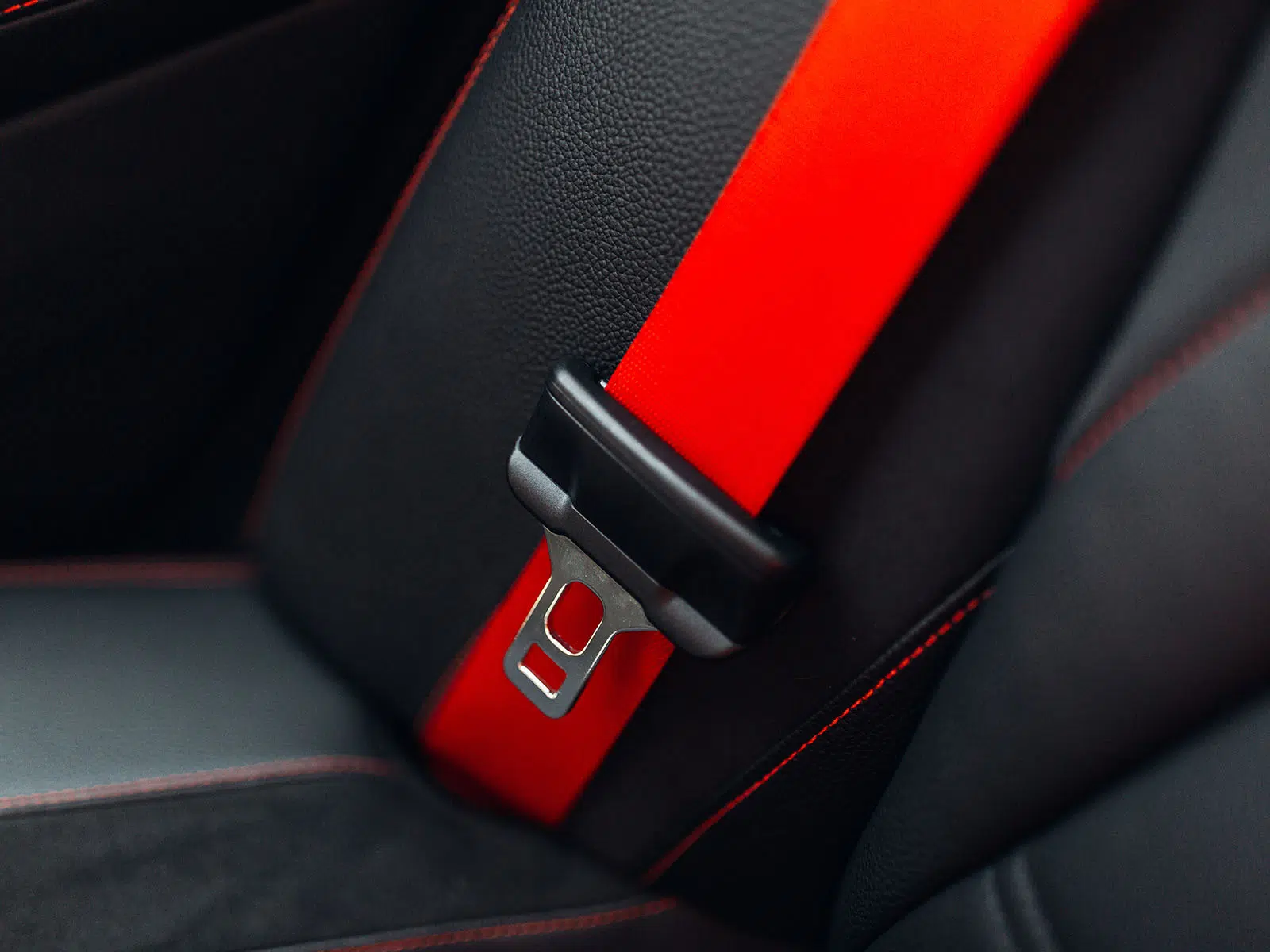
Seat belt components — loops, tongues, and buckles — require uniform, through-the-part hardness rather than the surface-to-core differentiation that case hardening provides. Neutral hardening, or through hardening, delivers exactly that, heating the part to a specified temperature and quenching it in oil to achieve consistent hardness throughout. For seat belt components, specifications typically require hardness up to 200 ksi.
Because seat belt components are visible to the end consumer, the cosmetics of these parts are important in addition to their mechanical properties. It’s important to keep the furnace free of soot and to thoroughly clean the parts both before and after heat treatment. Proper cleaning readies the part for secondary processing, ensuring the success of activities like polishing and chrome plating.
what process controls enhance precision in heat treating?
For automotive seat components, we typically make use of a continuous belt furnace for superior part-to-part temperature uniformity, increased throughput, reduced changeover times, and part loading flexibility. In the continuous belt furnace, ensuring that parts reach the proper austenitizing temperature is a chief concern. That’s why many of our control systems are aimed at maintaining correct temperatures for processing your parts, including:
Controlling how parts are positioned and loaded. Many heat treaters rely on employees to load parts manually onto the belt furnace, which can lead to inconsistencies in load rates and part overlap, and as a result, improper heat treatment. Any parts that happen to overlap will suffer from masking, where one part laying atop another partially shields the one below from the furnace’s heat, resulting in only partial heat treatment. This issue can extend turnaround
times to account for reprocessing, and even worse, may cause improperly treated parts to enter your supply chain. To combat this risk, AST-Paulo employs an automated loading system that ensures consistent load rates and controls part overlap. In some cases, we have designed custom fixturing in-house that parts can be loaded into by hand to prevent nesting and ensure proper heat exposure on all part surfaces.
Measuring and controlling furnace temperature. Properly processing your parts the first time is what allows a commercial heat treating partner like AST-Paulo to deliver on tight turnaround times and keep up with high volumes. That’s why we measure furnace temperature in the continuous belt furnace in four different zones so we can get a clear picture of what is happening with your parts during processing—this gives us scientific certainty that proper heat treatment has taken place.
Measuring and controlling furnace firing rates. Furnace firing rates must be optimized to properly process your parts. The AST-Paulo Belt System (PBS) varies and adjusts furnace temperatures to prevent fluctuations in heat. If issues are detected, the process will automatically stop and parts will be quarantined until the issue is resolved. These measures prevent any out-of-spec parts from leaving our facility, reducing your risk for part failure, recalls, and other ramifications.
Verifying part temperatures as they exit the furnace. Using an infrared temperature gun, we measure how hot parts are as they exit the furnace. This is a CQI-9 standard that helps verify that parts achieved the targeted temperature while in the furnace and allows us to quickly identify any potentially defective parts.
Monitoring carbon content in the furnace atmosphere. If carbon levels are incorrect (either too high or too low) during processing, the parts will not gain the targeted surface hardness or may even lose hardness and durability through decarburization. Most commercial heat treaters only control and measure carbon from one location inside the furnace. AST-Paulo monitors carbon across three furnace zones. If improper carbon levels are detected, alarms sound, processing is stopped, and parts are quarantined. This monitoring is crucial to proper treatment of the parts.
Maintaining these process controls is the only way to ensure excellent precision and repeatability for your parts.
If you are experiencing challenges with your current heat treatment partner, working on new or updated part designs, or simply need help meeting your throughput needs, we can help. Our thermal processing experts can assist with your needs, from simple to complex, and yield unparalleled results in quality and precision for your automotive parts. Request a quote today to get started.
 English
  Español de México