

steel hardness conversion calculator
how to use this calculator
- Conversions are for non-austenitic steel only. Conversion values are only approximations and may be inaccurate for specific applications.
- Conversion should be used only when it is impossible to test under conditions specified, and all conversions should be made with discretion.
- Round all conversions to the nearest whole number, following ASTM E29 rounding practices.
- Use the largest load scale that can be tolerated for the dimension and nature of the specimen.
- Report both the original and converted hardness numbers. For example: 85 HR15N (49 HRC), which HRC is the original scale and HR15N is the scale being converted to.
- Refer to appropriate ASTM E140 & A370 standards for additional information.
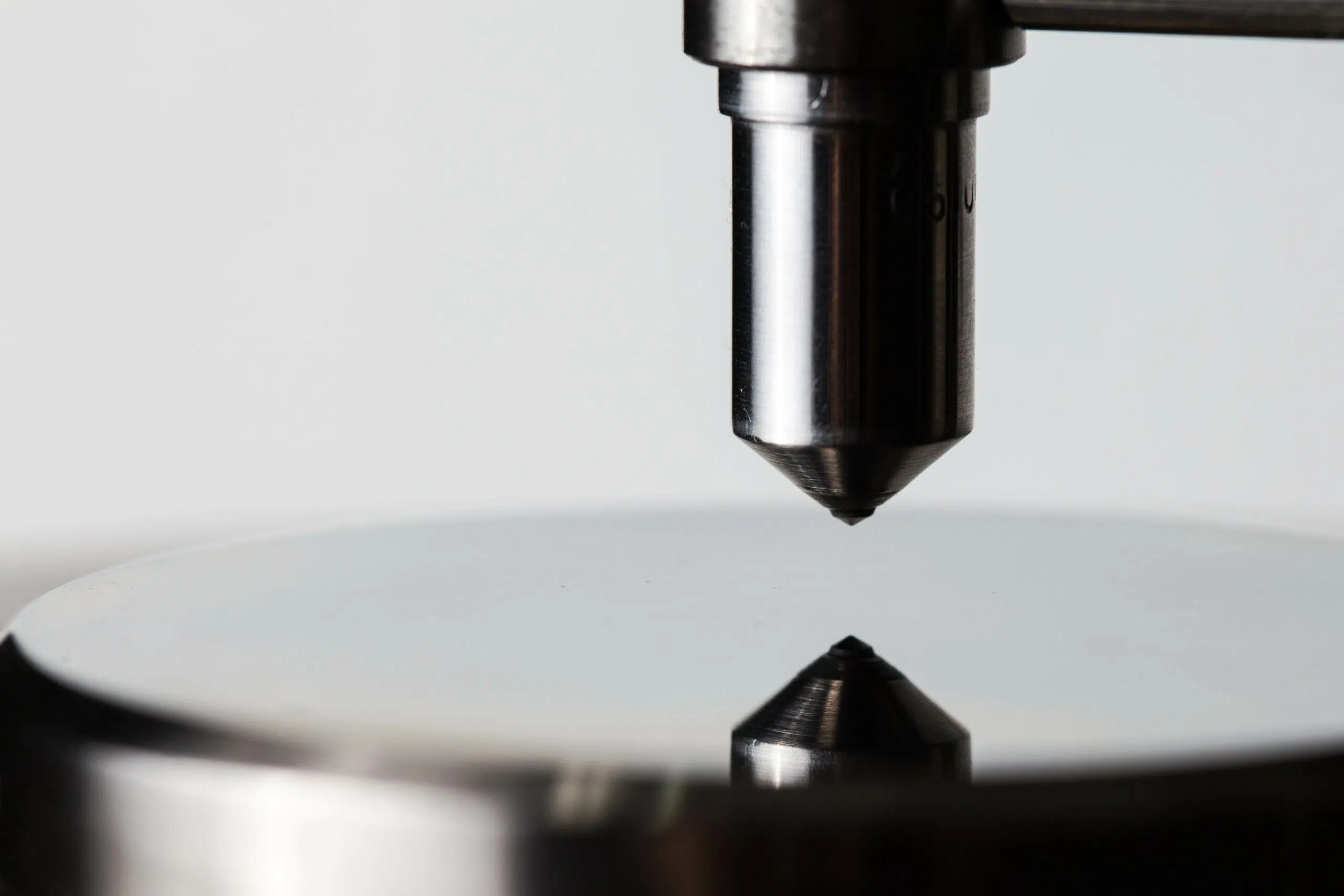
how is hardness measured?
Hardness is a material’s resistance to permanent shape change—specifically deformation like indentation. It’s a key indicator of how a part will withstand stress, wear, or mechanical impact during service.
indentation-based testing
Most hardness testing methods use mechanical indentation, where a tool—typically a tungsten carbide, or diamond tip—is pressed into the material’s surface. The depth or size of the indentation determines the hardness number.
Influencing Factors
Three core variables affect hardness test results:- Test Load – How much force is applied.
- Indenter Shape & Material – Ball, conical, or pyramid tips behave differently.
- Material Microstructure – Grain size, phase distribution, and heat treatment all matter.


a note on conversions
Hardness conversions are only approximate. Because each metal behaves differently under load, direct conversions across different hardness scales (e.g., HRC to HB) may lead to errors. Direct testing is recommended when precision is critical.
understanding hardness scales
Different scales are used depending on the part size, material type, and application. Here’s a breakdown of the most common:
rockwell hardness (HR)
What It Measures:
The Rockwell test evaluates how deep an indenter penetrates a material under a standard load, making it one of the fastest and most convenient methods available.
How It Works:
A two-step process is used: an initial minor load sets a baseline, then a major load is applied. The depth difference determines the hardness number. The scale used—A, B, C, etc.—depends on the material and the type of indenter.
Why It’s Used:
Rockwell is the go-to for high-volume, production-based environments where fast, repeatable readings are required. It’s particularly useful in measuring metals like steel, aluminum, and brass.
Limitations:
Because Rockwell readings are influenced by surface conditions, it’s not ideal for thin materials, coatings, or parts with surface irregularities. For harder materials like hardened tool steel, HRC (Rockwell C) is the most commonly used sub-scale.
vickers hardness (HV)
What It Measures:
Vickers testing evaluates the material’s ability to resist plastic deformation under a precisely applied load from a diamond-shaped indenter.
How It Works:
The test applies a known load using a diamond pyramid-shaped indenter. Once the load is removed, the diagonals of the resulting indentation are optically measured. The surface area—not just depth—contributes to the final hardness number.
Why It’s Used:
Because the shape of the indenter works equally well on soft and hard materials, Vickers is extremely versatile. It’s especially valuable in testing thin cross-sections or small components, including microstructures like case-hardened surfaces.
Limitations:
Although highly accurate, the Vickers method is more time-intensive and often requires polished samples and controlled environments.
knoop hardness (HK)
What It Measures:
The Knoop test is designed for ultra-shallow indentations, ideal for coatings, plating, or delicate materials.
How It Works:
A uniquely shaped diamond indenter creates an elongated rhomboid impression. Only one diagonal is measured, allowing for extreme precision with minimal material disruption. This is especially critical in microhardness profiling.
Why It’s Used:
Knoop is often deployed in metallographic labs to assess coating hardness, surface treatments, or very thin layers where even small indentations might cause damage. It’s also used to evaluate hardness gradients across a cross-section.
Limitations:
Knoop testing is not designed for bulk hardness or structural components. It requires high magnification and operator skill, making it more of a laboratory method than a shop floor solution.
brinell (HBW)
What It Measures:
Brinell evaluates the material’s resistance to indentation using a large-diameter ball and a heavy load, making it ideal for materials with variable grain structures or large component parts.
How It Works:
A 10mm tungsten carbide ball is pressed into the surface under a defined load, typically for 10–15 seconds. The diameter of the indentation is then measured optically. The result is an average hardness over a broad area.
Why It’s Used:
Because Brinell testing samples a larger surface area, it’s often preferred for heterogeneous materials like castings or forgings. It gives a more representative reading where microstructural inconsistencies might affect other test methods.
Limitations:
The downside of Brinell is speed—it’s slower, less suited to small parts, and can leave large, visible marks. Optical measurement can also introduce variability if not performed consistently.
why conversion isn’t one-size-fits-all
Hardness numbers can be deceiving when taken out of context. Each testing method measures a material’s response to load in a specific way—whether by depth, area, or optical geometry—and those readings are shaped by far more than just the test procedure itself.
material behavior matters
Different materials, even with the same nominal hardness, don’t behave identically under stress. For example, two steels—one quenched and tempered, the other case-hardened—might both read 60 HRC. Yet the first has that hardness throughout its cross-section, while the second is only hardened at the surface. The implication for wear resistance, fatigue life, or crack propagation is dramatically different.
Beyond structure, things like carbon content, alloying elements, grain size, and prior heat treatments alter how a material responds to the same test. This variability makes one-to-one conversions across methods unreliable in critical applications.
load sensitivity and indenter interaction
Testing methods also apply very different loads over different geometries. A Brinell test uses a wide contact area, averaging hardness over a larger surface—useful for castings or inconsistent grain structures. Rockwell, by contrast, offers quicker results but is more influenced by surface treatments and near-surface inclusions. Vickers and Knoop go even further, measuring micro-level hardness in highly localized zones.
These nuances mean that a Brinell-to-Rockwell conversion may look good on paper but misrepresent what’s actually happening in the material under operating conditions.
misleading data in the field
We’ve seen real-world cases where relying solely on a converted value led to incorrect material assumptions. One example: A supplier specified a 300 HB minimum for a gear. A customer converted this to ~30 HRC and approved production. However, the gear was through-hardened, not case-hardened as intended. The result? A field failure within weeks due to insufficient surface fatigue resistance. If direct hardness testing had been used—backed by metallurgical review—the oversight could have been caught.
why AST-Paulo tests directly
We perform direct testing across all major scales in-house because we know how misleading conversions can be when material history isn’t fully understood. Our metallurgical and quality teams assess not only the test results but also the context: material certification, heat treatment paths, and service requirements. That’s the level of detail necessary when the stakes are high.
material behavior matters
Different materials, even with the same nominal hardness, don’t behave identically under stress. For example, two steels—one quenched and tempered, the other case-hardened—might both read 60 HRC. Yet the first has that hardness throughout its cross-section, while the second is only hardened at the surface. The implication for wear resistance, fatigue life, or crack propagation is dramatically different.
Beyond structure, things like carbon content, alloying elements, grain size, and prior heat treatments alter how a material responds to the same test. This variability makes one-to-one conversions across methods unreliable in critical applications.


load sensitivity and indenter interaction
Testing methods also apply very different loads over different geometries. A Brinell test uses a wide contact area, averaging hardness over a larger surface—useful for castings or inconsistent grain structures. Rockwell, by contrast, offers quicker results but is more influenced by surface treatments and near-surface inclusions. Vickers and Knoop go even further, measuring micro-level hardness in highly localized zones.
These nuances mean that a Brinell-to-Rockwell conversion may look good on paper but misrepresent what’s actually happening in the material under operating conditions.
misleading data in the field
We’ve seen real-world cases where relying solely on a converted value led to incorrect material assumptions. One example: A supplier specified a 300 HB minimum for a gear. A customer converted this to ~30 HRC and approved production. However, the gear was through-hardened, not case-hardened as intended. The result? A field failure within weeks due to insufficient surface fatigue resistance. If direct hardness testing had been used—backed by metallurgical review—the oversight could have been caught.
why AST-Paulo tests directly
We perform direct testing across all major scales in-house because we know how misleading conversions can be when material history isn’t fully understood. Our metallurgical and quality teams assess not only the test results but also the context: material certification, heat treatment paths, and service requirements. That’s the level of detail necessary when the stakes are high.
Frequently Asked Questions
Can I convert from Brinell to Rockwell or Vickers?
Yes—but with caution. Conversions should be used with great care and careful consideration.
How do I find my hardness spec?
Start by checking the technical drawing or purchase order associated with your part. Hardness requirements are often defined as part of the material callout or under the heat treatment section. Look for a value paired with a scale—something like “58-62 HRC” or “285 HBW.” If you don’t see one, it may be embedded in a referenced spec such as an AMS, ASTM, or OEM standard (e.g., AMS 2759 or GM1234). Check out Cómo encontrar la especificación de dureza de la pieza para saber más.
How do I know which hardness scale applies to my part?
The choice depends on material type, size, and specification. If unsure, Paulo’s metallurgy team can advise and test accordingly.
What affects hardness testing accuracy?
Surface finish, part geometry, and testing environment can all influence results. That’s why Paulo uses tightly controlled methods and environments for all testing.
What’s the difference between microhardness and macrohardness testing?
Microhardness methods (Vickers, Knoop) are used for coatings or fine microstructure zones. Macrohardness (Rockwell, Brinell) is suited for bulk material properties.
have questions about part hardness?
Connect with a heat treating expert for support in meeting your hardness spec.
Connect with an expert
 Español de México
  English